REPORTED RELIEF AND UNWANTED EFFECTS
What pain reports leave unknown about KLOW peptide
People posting about their own use describe less pain and quicker healing. Those accounts come from users, without a trial checking who improved or why.
The short answer about reports of relief
Less pain, better healing, and bowel comfort appear in users' accounts. These people describe their own use of KLOW peptide, rather than taking part in a comparison trial.
Some people say lasting tendon or joint trouble eased sooner. Others felt less aching and believed their inflammation had settled.
Users link less swelling and irritation with KPV, and credit GHK-Cu, BPC-157, and TB-500 for repair, though separate experiments cannot establish the cause of an individual's relief after the mixture. Your safety question also needs a different kind of evidence.
Skin and digestive changes appear less often in the accounts. Some people also describe redness after a shot or tiredness early on.
Feeling better after using a mixture doesn't tell you what caused relief. Without a trial comparing treatments, rest, other care, and the injury's own healing could still explain a person's improvement.
The published ingredient studies mostly tested animals or cells grown outside the body. They didn't measure benefits and harm in people receiving KLOW.
TB-500 is banned under the drug rules that tested athletes follow. That ban is firm even while healing claims remain unsettled.
You can weigh a report of relief without treating the report as proof. Your question about safety still needs evidence that the mixture hasn't supplied.
KLOW peptide benefits: which changes people describe
People who use the mixture themselves report the changes below. These personal accounts aren't findings from a comparison study, and the reported benefits lack a trial checking what changed.
The accounts don't confirm what each vial held or how much was used. That leaves you unable to judge the amount or contents behind a claim.
The most often described changes concern pain and healing:
- Tendon and joint trouble seemed to ease. People mention Achilles, knee, and shoulder problems improving over roughly three weeks or four weeks. Some credit BPC-157 and TB-500, without a trial establishing that either caused relief.
- Muscles or joints hurt less. People sometimes describe less pain before they notice an injury change. Knee and shoulder relief alone cannot confirm that damaged tissue repaired itself.
- Aching eased or digestion felt better. Some people credit KPV and compare their experience with GLOW, which leaves KPV out. Those personal comparisons don't establish which mixture works better.
Less frequent accounts concern skin, digestion, and sleep:
- Skin seemed smoother or less dry. Some users link gradual changes in pores or skin to GHK-Cu. The changes took several weeks in their accounts, without measurements establishing skin repair.
- Digestion felt easier. Some users hadn't expected a change in bowel comfort. Separate KPV and BPC-157 bowel experiments give researchers reasons to investigate, without confirming relief from the mixture.
- Sleep or dreams seemed different. Some people describe better sleep or more vivid dreams. Your sleep question can't be settled by accounts without a treatment comparison.

KLOW side effects: which unwanted changes people describe
People describing their own KLOW use also mention unwanted changes. These are users' accounts of harm, without a comparison trial checking whether the mixture caused the complaints.
Skin near a shot is the most frequent complaint:
- Redness, itching, or swelling followed a shot. Users usually describe mild changes that passed quickly. The reports don't confirm the vial's contents or how cleanly the powder was mixed.
Other complaints appear less often:
- Energy fell soon after starting. Some users report low energy on days one to three and improvement afterward. A trial hasn't established what caused either change.
- A headache or light-headed feeling passed quickly. Users generally describe a short spell. You cannot establish why the spell occurred from that account.
- Skin felt warm or flushed. Some people felt warm shortly after using the mixture. Researchers haven't established that KLOW caused the warmth or why the change occurred.
- The stomach felt upset. Some people describe nausea rather than the easier digestion others mention. Opposite accounts don't tell you which change, if either, came from the mixture.
- Little seemed to happen. Some users question their vial's contents after feeling no effect. A discussion can't establish whether a vial contained the stated ingredients.
What sport rules and your health history can change
For tested athletes, TB-500 is banned. WADA, which sets drug rules for many sports, bans thymosin beta-4 during events and between competitions [7].
TB-500 comes from that protein and falls under the ban. Calling personal use research doesn't change an athlete's duty under those rules.
Cancer raises a possible concern about blood supply. BPC-157, TB-500/thymosin beta-4, and GHK-Cu can promote the growth of blood vessels [2][5].
Blood keeps a solid tumor growing, as well as supplying an injury during repair, so encouraging new vessels raises a question about whether a tumor might benefit too. Researchers haven't established that harm in people.
A human trial hasn't established that these ingredients cause cancer to worsen. For you, present cancer or recent cancer treatment makes that uncertainty part of a health decision.
The mixture has no comparison test of benefit or harm. Most ingredient experiments involved rodents or cells kept on laboratory dishes.
Nobody has made a fair comparison using KPV with GHK-Cu, BPC-157, and TB-500 together. Extra healing from that combination remains a claim drawn from separate work.
BPC-157 clears quickly, and KPV and GHK-Cu clear even faster [7]. Blood levels can rise and fall differently even though the ingredients shared a vial.
Copper raises another concern for some people. The vial contains roughly 50 mg of GHK-Cu out of 80 mg total powder.
GHK-Cu delivers copper along with the small protein piece, raising a concern for people with Wilson's disease because their bodies have trouble controlling copper and might accumulate copper with repeated treatment [4]. Human studies haven't measured that possible buildup.
Infection and immune illness need different questions. KPV reduced inflammation-causing substances in lab tests using both gut cells and cells of the immune system [3].
During infection, inflammation helps your body fight the invading germ, so slowing that response could interfere with a useful defense, though human tests haven't settled that concern with KPV. Fighting the infection remains the question in that setting.
In some immune illnesses, your body's defenses attack healthy tissue instead. Slowing inflammation might matter differently there, and human tests haven't established the effect of KPV in that setting either.
Those are separate illnesses with separate unanswered safety questions. Neither animal nor cell results establish the outcome for you.
Weight loss isn't an established use for KLOW. The ingredients aren't proven slimming medicines or drugs that copy GLP-1, an appetite hormone.
Some users describe changes in how their bodies use food. Separate healing experiments don't establish those claimed benefits.
Two routes, two people carrying the risk
Who answers the questions above
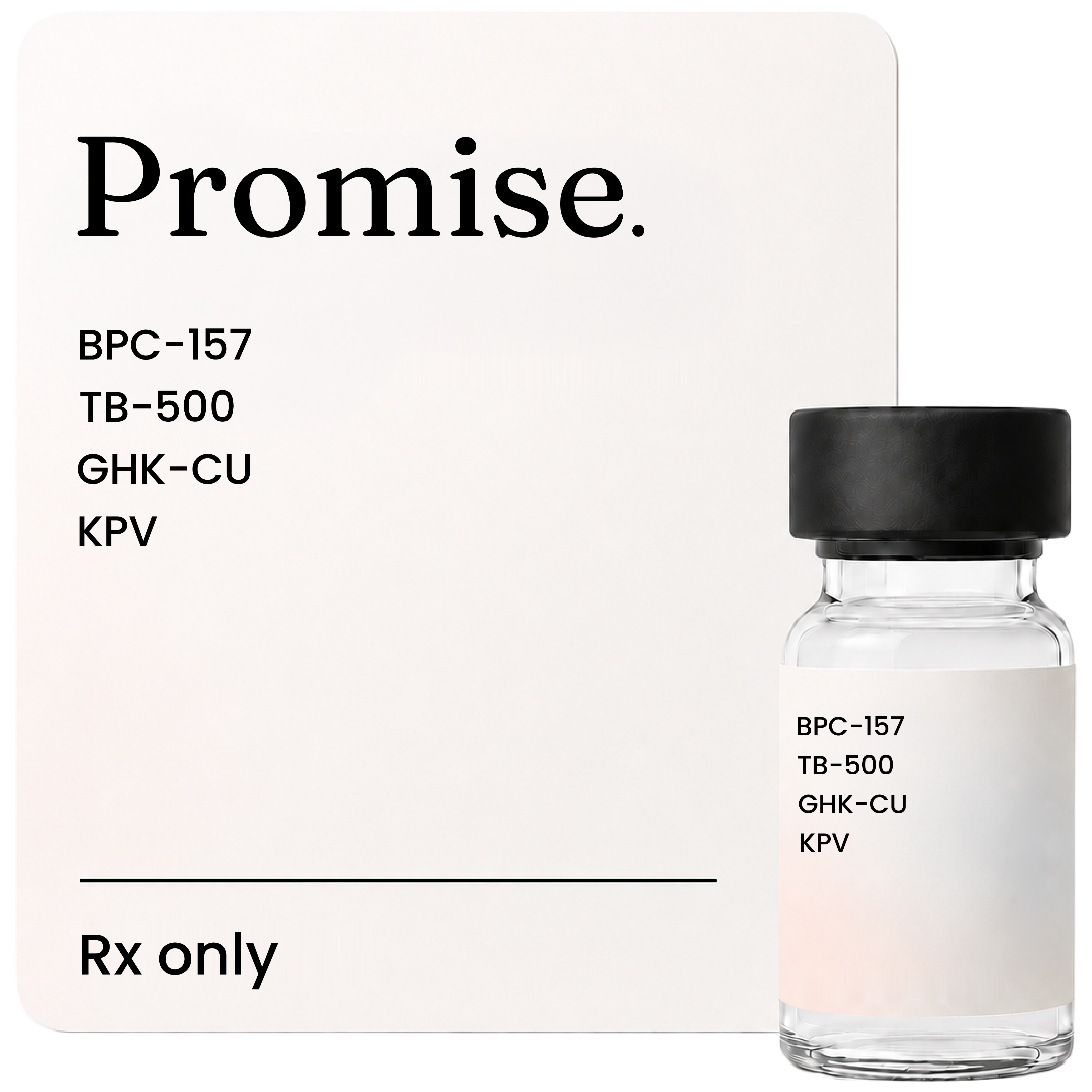
Every caution on this page is a judgment somebody has to make before the first injection — copper handling, autoimmune status, cancer history, drug testing. In the research-chemical route the person making all four is the buyer, working from a datasheet. KLOW prescribing is now part of care at Promise Peptides (mypromise.com); the clinician assessing the request has a U.S. license and decides whether to write a prescription. Some requests end with no prescription. The service sees patients in the U.S. alone, and the menu of care changes according to both state and treatment. This compounded blend has no FDA approval. That changes who is accountable for the decision, not what the literature knows about the blend — the four-arm combination remains untested either way.
KLOW vs GLOW: what differs and what has not been compared
GLOW contains GHK-Cu, BPC-157, and TB-500; adding KPV makes KLOW. Separate early experiments found that KPV reduced bowel inflammation.
Some people who used the mixtures describe more relief with KLOW. Those people aren't reporting results from a trial comparing both mixtures.
You cannot identify the cause of a difference from their accounts. The extra ingredient gives researchers a question to test, without an answer yet.
WOLVERINE is a further mixture with different ingredients. The names alone can't tell you which treatment, if any, would help your injury.